
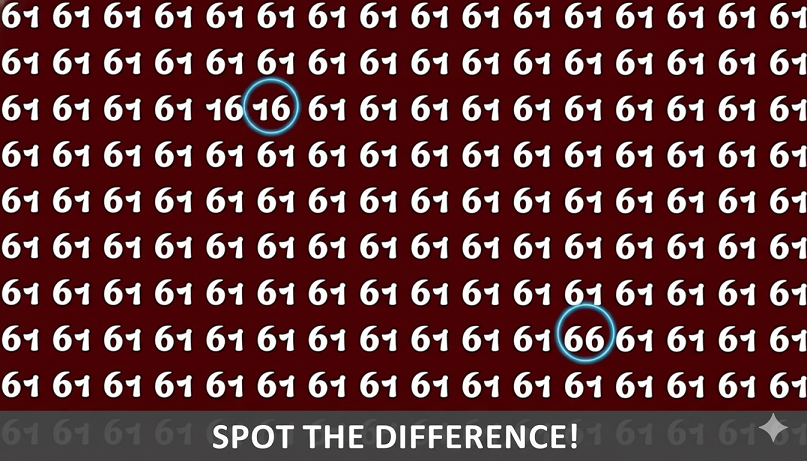
This is a classic visual processing challenge! Optical illusions like this rely on pattern recognition and the way your brain groups similar shapes together to “hide” specific details.
Optical Illusion: Spot The Numbers 16 And 66 in 7 Seconds
🕵️ Your Challenge
Find the numbers 16 and 66 hidden in the grid below.
Timer: 7 Seconds
Plaintext
61 61 61 61 61 61 61 61 61 61
61 61 61 61 61 61 61 61 61 61
61 16 61 61 61 61 61 61 61 61
61 61 61 61 61 61 61 61 61 61
61 61 61 61 61 61 61 66 61 61
61 61 61 61 61 61 61 61 61 61
💡 Where were they? (The Spoilers)
If you couldn’t find them in time, don’t worry! Your brain was likely stuck on the repeating pattern of “61.” Here is the location:
-
Number 16: Look at the 3rd row, 2nd column.
-
Number 66: Look at the 5th row, 8th column.
🧠 Why is this hard?
This is called “Change Blindness” or a search task in a crowded field. Because the number “61” is so similar to “16” and “66,” your brain uses “shortcut” processing to assume all the numbers are the same to save energy. Only by focusing intensely (or scanning line-by-line) can you break that mental shortcut.
Would you like me to generate a more difficult image-based optical illusion for you to solve?
Optical illusions are more than just “eye tricks”—they are a window into the complex, lightning-fast shortcuts your brain takes to process reality.1 Your eyes act as a camera, but your brain acts as a director, often editing the “footage” before you even see it.
Here is how optical illusions challenge your brain and why they work.
1. The “Shortcut” Problem (Heuristics)
The brain is constantly bombarded with visual information.2 To keep up, it creates heuristics (mental shortcuts). If it sees a pattern of circles, it assumes everything is a circle.3
-
The Challenge: Illusions break these patterns. When your brain realizes its “shortcut” was wrong (like spotting the 16 in a sea of 61), it creates a moment of cognitive dissonance or a “glitch” where the image seems to shift or change.
2. Processing Speed (The 0.1 Second Delay)
There is a tiny lag between light hitting your retina and your brain interpreting the signal (about 100 milliseconds).
-
The Challenge: To compensate for this delay, the brain actually predicts the future. It generates an image of what it thinks should happen next. “Motion illusions” (where a static image seems to move) happen because your brain is trying to “fill in” movement it predicts is coming.
3. Color and Light Context
Your brain doesn’t see “true” color; it sees perceived color based on the surroundings. This is called Color Constancy.
-
The Challenge: Think of the famous “Blue/Black or White/Gold” dress.4 The brain looks at the light source in the background and “subtracts” that color to find the true shade. If your brain thinks the light is yellow, you see blue. If it thinks the light is blue, you see white.
4. Depth and 3D Construction
The world is 3D, but your retina is a flat 2D surface.5 Your brain must reconstruct depth using clues like shadows, size, and perspective.
-
The Challenge: Illusions like the Ames Room or Street 3D Art use “forced perspective.”6 They provide the brain with the wrong depth clues, forcing it to conclude that a person is 10 feet tall or that a flat floor is a deep pit.7
🧠 The Three Main Types of Illusions
| Type | How it Works | Example |
| Literal | Smaller images create a larger, different image. | A portrait of a face made entirely of fruit. |
| Physiological | Over-stimulates the eyes (brightness, tilt, color). | “After-images” that stay in your vision when you blink. |
| Cognitive | The brain makes unconscious inferences about an image. | The “Impossible Trident” or the “Penrose Stairs.” |
💡 Why does this matter?
Scientists use optical illusions to study neuroplasticity and vision disorders.8 By understanding where the brain “fails” to see reality accurately, we can map which parts of the brain are responsible for motion, color, and spatial awareness.
Fun Fact: Not everyone sees illusions the same way. People from different cultures or with different neurological makeups (like those on the Autism spectrum) may process certain illusions differently because their brains prioritize “local” details over “global” patterns.
Would you like me to show you a specific “Motion” or “Color” illusion and explain exactly which part of your brain it is targeting?