
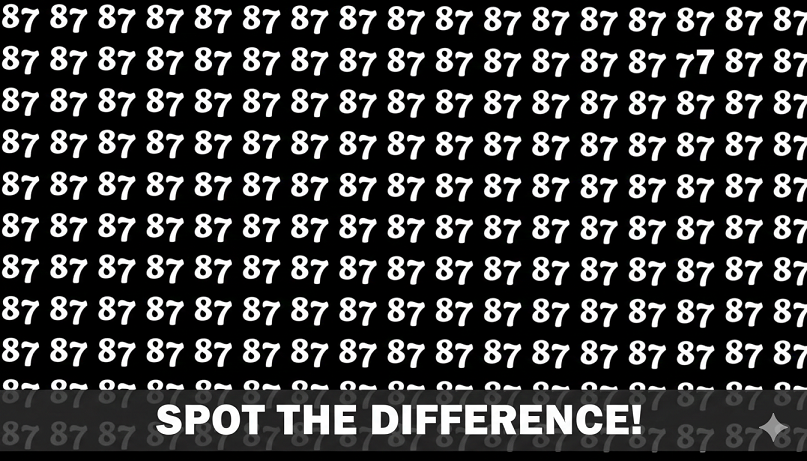
Get ready! This is a classic “mental flip” challenge. Because 78 and 87 use the same digits, your brain’s “auto-pilot” mode will try to tell you they are all the same.
Observation Challenge: Spot The Number 78 Among 87 in 7 Seconds
🕵️ The Challenge
Find the number 78 hidden in this grid.
Timer: 7 Seconds
Plaintext
87 87 87 87 87 87 87 87 87 87
87 87 87 87 87 87 87 87 87 87
87 87 87 87 87 87 87 87 87 87
87 87 87 87 87 87 87 87 87 87
87 87 87 78 87 87 87 87 87 87
87 87 87 87 87 87 87 87 87 87
💡 The Reveal
Did you find it before the 7 seconds were up?
-
The Answer: Look at the 5th row, 4th column.
🧠 Why did your brain struggle?
This is known as “The Inversion Effect.” Your brain doesn’t read every single digit when scanning a pattern; it looks at the “shape” of the cluster. Since 87 and 78 have the exact same visual weight and components, your eyes likely glided right over the correct answer unless you broke the pattern by scanning vertically or right-to-left.
Optical illusions are the ultimate “glitch in the matrix” for your mind. They prove that you don’t actually see with your eyes—you see with your brain.1 While your eyes capture light, your brain is the one that interprets it, and it often takes shortcuts that lead to fascinating mistakes.2
Here is a breakdown of how these illusions challenge your neural pathways.
1. The “Auto-Fill” Glitch (Heuristics)
Your brain is constantly trying to save energy.3 To do this, it uses heuristics, or mental shortcuts, to predict what it’s seeing based on past experiences.4
-
The Challenge: When you look at a repeating pattern (like a grid of numbers), your brain “auto-fills” the rest of the image to match the first few things it saw. This is why you can’t easily spot a 78 in a sea of 87—your brain has already decided the pattern is uniform.
2. The 0.1-Second Time Gap
There is a roughly 100-millisecond delay between the moment light hits your eyes and the moment your brain creates a conscious image.
-
The Challenge: To compensate for this lag, your brain predicts the future. It shows you what it thinks will happen next.5 “Motion illusions” (where static images seem to swirl) happen because your brain is confused by high-contrast shapes and incorrectly applies its “motion prediction” logic.6
3. Context & Color Constancy
Your brain doesn’t care about the “true” color of an object; it cares about what the color looks like under different lighting.
-
The Challenge: In the famous “Dress” illusion (Blue/Black vs.7 White/Gold), your brain looks at the background lighting. If it assumes the light is warm, it subtracts the yellow and you see blue. If it assumes the light is cool/shadowy, it subtracts the blue and you see white.8 Your brain is literally editing the color in real-time.
🎨 The Three Categories of Illusions
| Type | How it Works | Example |
| Literal | Small objects are arranged to create a larger image. | A face made out of clouds or flowers. |
| Physiological | Over-stimulates the eyes with brightness or tilt. | The “black dots” that appear in the intersections of a white grid. |
| Cognitive | Your brain makes an unconscious (and wrong) inference. | The “Impossible Triangle” that cannot exist in 3D space. |
🧠 Why This is “Healthy” for Your Brain
Engaging with optical illusions is like a gym workout for your neurons.
-
Improves Focus: It trains you to ignore “global” patterns and look for “local” details.
-
Neuroplasticity: It forces the brain to reconcile two conflicting “realities,” which strengthens the connection between the visual cortex and the frontal lobe.
-
Critical Thinking: It teaches you that your first impression of “reality” isn’t always the truth.
🕵️ Quick Mini-Challenge
Try to read this:
“I lvoe yuo mroe tahn pzi za.”
Even though the letters are scrambled, you likely read it perfectly. This is because your brain reads words as a whole, not letter by letter—another shortcut that illusions exploit!9
Observation Challenge: Spot The Number 78 Among 87 in 7 Seconds