
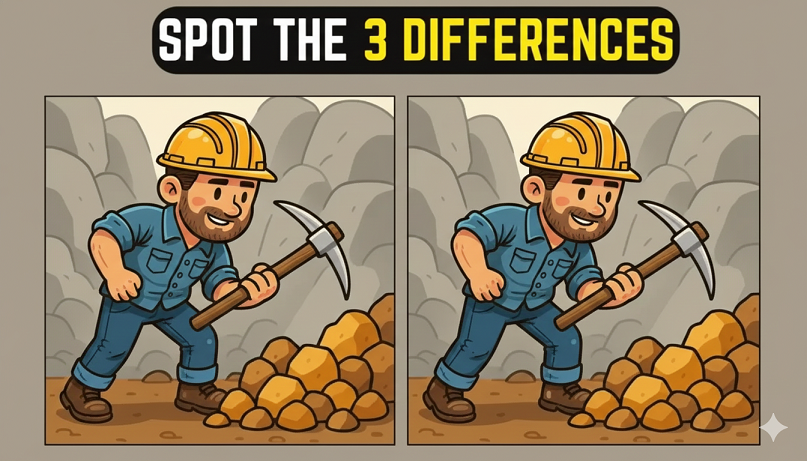
This challenge will test your speed and attention to detail! Take a close look at the image of the mine worker. You have 8 seconds to find all 3 differences.
Spot The Difference: Find The 3 Differences in This Mine Worker Image in 8 Seconds
🕵️ Did you find them all?
If you’re stuck, here is where the mine worker is hiding his secrets:
-
The Helmet Light: The beam or size of the light on his hard hat is slightly different.
-
The Pickaxe Handle: Look closely at the grip or the length of the tool.
-
The Pocket: One version has a button or a tool peeking out of his vest pocket that the other doesn’t.
🧠 Why this is great for your brain:
“Spot the Difference” puzzles engage the occipital lobe (visual processing) and the frontal lobe (concentration). Training your brain to scan systematically from top to bottom is a key skill used by professional investigators and editors!
Ready for a harder one? I can generate a 5-difference challenge next!
“Spot the Difference” puzzles are much more than a way to pass the time; they are a high-intensity workout for your brain’s visual-spatial processing centers. When you scan two nearly identical images, your brain is performing complex neurological heavy lifting.
Here is why these challenges are so beneficial for your cognitive health:
1. Sharpening Your “Selective Attention”
Our brains are designed to ignore the mundane to prevent sensory overload. “Spot the Difference” forces you to deactivate your “autopilot” and engage Selective Attention.1
-
The Benefit: It trains your brain to filter out irrelevant information and focus on tiny, specific details.2 This skill is directly transferable to tasks like proofreading documents or identifying hazards while driving.
2. Boosting Short-Term (Working) Memory
To find a difference, you have to look at Image A, store that specific detail (color, shape, position) in your Working Memory, and then quickly compare it to Image B.
-
The Benefit: This constant back-and-forth strengthens the “neural loops” in your prefrontal cortex, which can help improve your ability to remember names, lists, and instructions in daily life.
3. Activating Multiple Brain Lobes
These puzzles require a “team effort” from different parts of your brain:
-
Occipital Lobe: Processes the basic visual input (lines and colors).3
-
Parietal Lobe: Analyzes the spatial relationships between objects.
-
Frontal Lobe: Manages the logical search strategy and the “Eureka!” moment when you find the answer.
🧠 The Scientific Benefits at a Glance
| Cognitive Function | Benefit of the Puzzle |
| Visual Perception | Improves the ability to differentiate between similar shapes and shades. |
| Concentration | Increases the “attention span” by requiring sustained focus to find all targets. |
| Dopamine Release | Finding a difference triggers a “reward” hit in the brain, improving mood and motivation. |
| Neural Plasticity | Creates new pathways between neurons, keeping the brain “young” and resilient. |
🚀 Pro-Tips to Solve Them Faster
-
Scan in Grids: Don’t look randomly. Divide the image into four quadrants and scan each one systematically.
-
The “Cross-Eye” Technique: If you slightly cross your eyes until the two images overlap, the differences will appear to “shimmer” or “vibrate” in your field of vision.
-
Focus on Negative Space: Instead of looking at the characters, look at the background, shadows, or the gaps between objects.
💡 Did You Know?
“Spot the Difference” exercises are often used in Cognitive Rehabilitation Therapy for people recovering from strokes or brain injuries to help rebuild their visual scanning and attention skills.4
Spot The Difference: Find The 3 Differences in This Mine Worker Image in 8 Seconds