
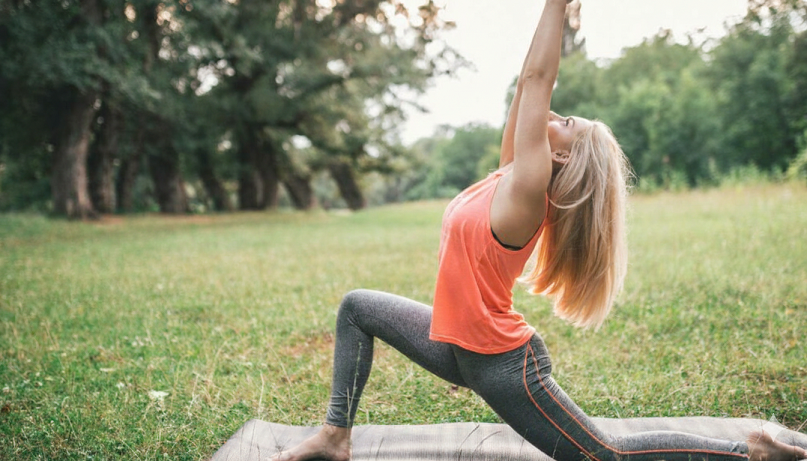
Improving balance and coordination is about more than just standing on one leg; it’s about strengthening your core, stabilizing your joints, and enhancing your proprioception (your body’s ability to sense its position in space).
Here are the 13 best yoga exercises to help you build a rock-solid foundation.
Phase 1: The Foundation (Beginner)
These poses build the initial stability required for more advanced balancing.
-
Mountain Pose (Tadasana): Stand with feet together. Distribute weight evenly. It sounds simple, but finding true center is the first step to balance.
-
Tree Pose (Vrksasana): Place one foot on your inner calf or thigh (avoid the knee). Press your foot into your leg and your leg into your foot to create a stable midline.
-
Warrior I (Virabhadrasana I): A wide stance with the back foot angled. This builds lower body strength and coordination between the hips and upper torso.
-
Plank Pose: Essential for core stability. A strong core is the “anchor” for every balancing pose.
Phase 2: Dynamic Stabilization (Intermediate)
These poses require you to move your center of gravity or extend your limbs.
-
Eagle Pose (Garudasana): Wrap one leg over the other and one arm under the other. This compresses the joints and requires intense focus to stay upright.
-
Warrior III (Virabhadrasana III): Balance on one leg while your body forms a “T” shape. This is the gold standard for testing leg and glute stability.
-
Half Moon Pose (Ardha Chandrasana): Similar to Warrior III but with the chest open to the side. It challenges your vestibular system (inner ear balance).
-
Dancer’s Pose (Natarajasana): A combination of balance, backbend, and focus. It requires coordination between the kicking back leg and the reaching front arm.
-
Extended Hand-to-Big-Toe Pose (Utthita Hasta Padangusthasana): Standing on one leg while holding the other leg out in front or to the side.
Phase 3: Advanced Coordination & Strength
These poses integrate total body control and arm-balancing.
-
Crow Pose (Bakasana): The first arm balance for many. It teaches you how to shift your weight forward and find the “sweet spot” of gravity.
-
Side Plank (Vasisthasana): Balancing on one hand and the outer edge of one foot. This builds incredible oblique strength and side-body coordination.
-
Chair Pose on Tiptoes (Utkatasana Variation): Sink into a deep chair pose and lift your heels as high as possible. This strengthens the ankles and calves.
-
Headstand (Sirsasana) or Tripod Prep: Inverting the body is the ultimate test of coordination, as it requires you to re-orient your sense of “up” and “down.”
Comparison Table: Balance vs. Focus
| Pose | Primary Muscle Group | Difficulty | Coordination Key |
| Tree Pose | Calves, Ankles | Low | Foot-to-leg pressure |
| Warrior III | Hamstrings, Glutes | Medium | Hips squared to floor |
| Eagle Pose | Full Body Joints | Medium | Squeezing to the midline |
| Half Moon | Obliques, Hips | High | Gaze (Drishti) shift |
| Crow Pose | Core, Forearms | High | Gaze forward, not down |
💡 3 Tips to Improve Your Balance Quickly
-
Find Your Drishti: Fix your eyes on a single, non-moving point on the floor or wall.
-
Micro-bend the Knee: Never lock your standing knee; a slight bend allows your muscles to “micro-adjust” to maintain balance.
-
Use Your Toes: Spread your toes wide like a fan to increase the surface area of your “base.”